

Medication mistakes in assisted living can be easy to underestimate. A resident may take several prescriptions at different times of day, receive a new order after a hospital visit, need help opening containers, or rely on staff to make sure medication is available when it is due. A single communication or documentation error can affect an entire medication routine.
California assisted living facilities, many of which are licensed as Residential Care Facilities for the Elderly (RCFEs), operate differently from skilled nursing facilities. In assisted living, unlicensed staff commonly assist residents with self-administered medication rather than independently administering medication themselves. That distinction affects what staff may do, how they must be trained, and what documentation the facility must maintain.
A medication problem does not automatically establish neglect. Residents can refuse medication, prescriptions can change quickly, and adverse effects can occur even when directions are followed. The more useful questions are whether the facility had accurate orders, whether staff stayed within the limits of medication assistance, whether required training and documentation were in place, and whether changes in the resident’s condition were recognized and addressed.
Medication Assistance in Assisted Living Is Not the Same as Nursing Care
California regulations require facilities to assist residents with self-administered medications when needed. In practical terms, the medication remains the resident’s medication, while trained staff provide only the level of assistance permitted by law and appropriate to the resident’s abilities.
Job titles such as “med tech” or medication aide do not give unlicensed staff the same authority as licensed medical professionals. California law specifically states that its medication-training requirements do not authorize unlicensed personnel to directly administer medications. Injections are an important example: staff who are not otherwise authorized by law may not administer them, although a capable resident may self-administer and an appropriately skilled professional may provide the injection when needed.
This distinction is especially important when a resident’s condition changes. A person who once managed medications independently may later develop poor vision, tremors, memory impairment, weakness, or confusion. The facility may need to increase permitted assistance, update the resident’s appraisal, involve the prescribing practitioner, or arrange for licensed medical support rather than informally asking unlicensed staff to take over tasks beyond their role.
What Does “Assistance With Self-Administration” Mean?
California’s rules permit assistance with medications that are normally prescribed for self-administration and authorized by the resident’s physician or other appropriate prescriber. Assistance may also be needed because of conditions such as tremor, failing eyesight, or similar limitations.
The regulations also protect the resident’s right to make choices about medication. Assistance with self-administration does not include forcing a resident to take medication, hiding or disguising medication in food or another substance without the resident’s knowledge and consent, or otherwise overriding the resident’s right to refuse.
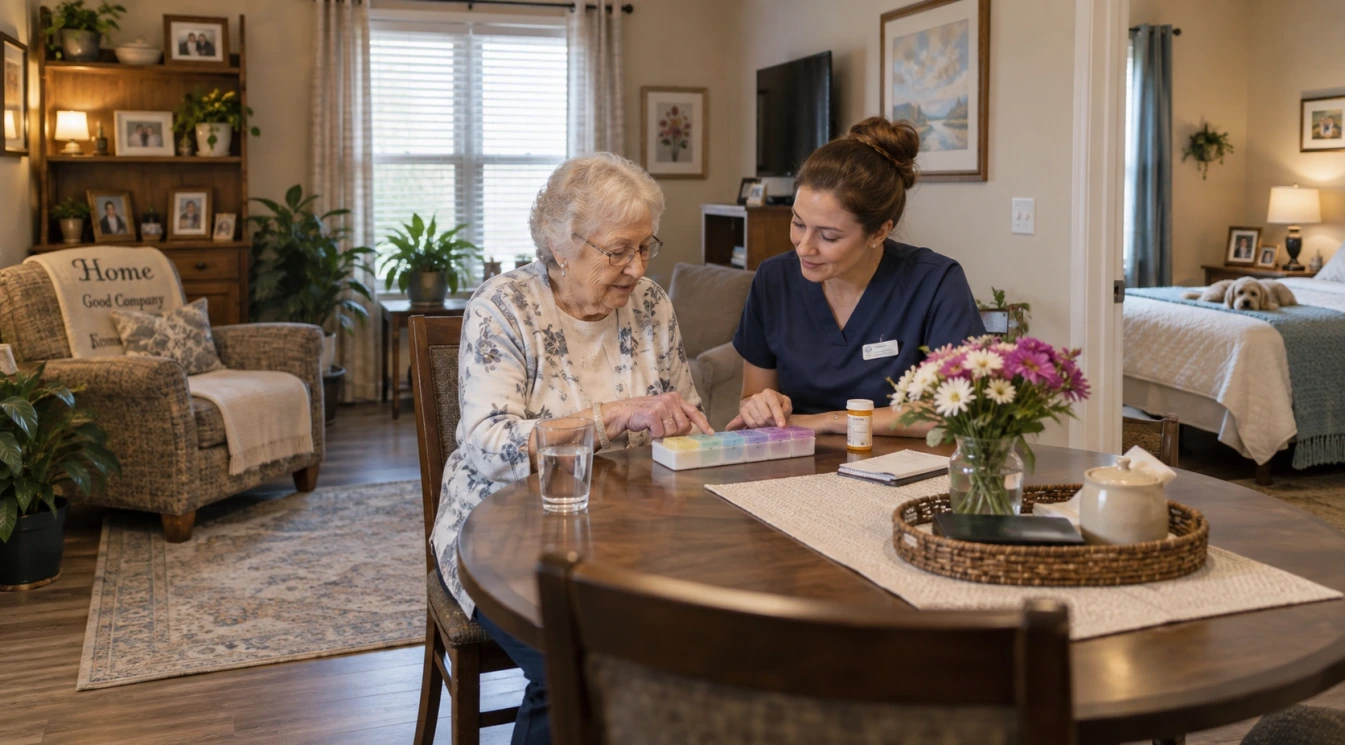
In day-to-day care, permitted assistance may include reminders, bringing the medication to the resident, helping with packaging or containers, and observing the process in a manner consistent with the resident’s abilities and the facility’s procedures. The level of assistance appropriate for one resident may be very different from what another resident needs.
Staff Who Assist With Medication Need Specific Training
California requires additional medication training for employees who assist residents with self-administration. The amount of initial training depends on the licensed size of the facility.
- In facilities licensed for 16 or more residents, staff who provide medication assistance generally must complete 24 hours of initial medication training, including 16 hours of hands-on shadowing before assisting residents.
- In facilities licensed for 15 or fewer residents, the initial requirement is generally 10 hours, including six hours of hands-on shadowing before medication assistance begins.
- Employees who continue assisting with medication must also complete eight hours of medication-related in-service training during each succeeding 12-month period.
For larger facilities licensed for 16 or more residents, California law also requires documentation showing that a consultant pharmacist or nurse has reviewed the facility’s medication-management program and procedures at least twice each year.
These requirements reflect the risks involved in medication assistance. Staff need to understand the limits of their role, medication orders, documentation, common side effects and adverse reactions, communication with health professionals, and what to do when the medication on hand does not match the resident’s current plan.
How Medication Errors Can Happen in Assisted Living
A medication problem can result from a single mistake or from several small failures occurring together. Examples may include:
- A scheduled medication is missed or offered at the wrong time
- A resident receives assistance with medication that belongs to someone else
- Staff continue using an old order after a physician changes or discontinues a prescription
- A new hospital discharge medication list is not reconciled with the facility’s existing records
- A duplicate medication remains active after a prescription change
- A resident who needs assistance is left to manage a complicated regimen alone
- Medication is unavailable because a refill was not obtained in time
- A medication requiring refrigeration or secure storage is not stored properly
- Staff do not document a PRN medication or the resident’s response as required
- An employee provides medication assistance before completing required training
Not every discrepancy causes injury, but repeated inconsistencies can make it difficult to know whether the resident actually received the medication regimen the prescriber intended.
Medication Orders Need to Follow the Resident When Care Changes
Transitions are a common point of vulnerability. A resident may return from the hospital with a different dose, a newly prescribed medication, or instructions to stop something that was previously taken every day. A specialist may also change a prescription without the facility immediately recognizing that the medication list has changed.
Good medication management depends on more than having the right bottles in a cabinet. The facility needs current information that matches the resident’s actual orders. When the pharmacy label, facility record, physician order, and hospital discharge instructions do not agree, the discrepancy needs clarification rather than guesswork.
This is where communication among the resident, family, pharmacy, prescribing practitioner, and outside medical providers becomes especially important. An outdated medication list can create risk even when individual caregivers are trying to follow the information available to them.
Centrally Stored Medications Must Be Secured and Documented
Some residents are capable of keeping and managing their own medications. In other situations, medications must be centrally stored because refrigeration is required, a physician has determined that possession would be hazardous, or the resident’s condition or the circumstances in the facility make central storage necessary.
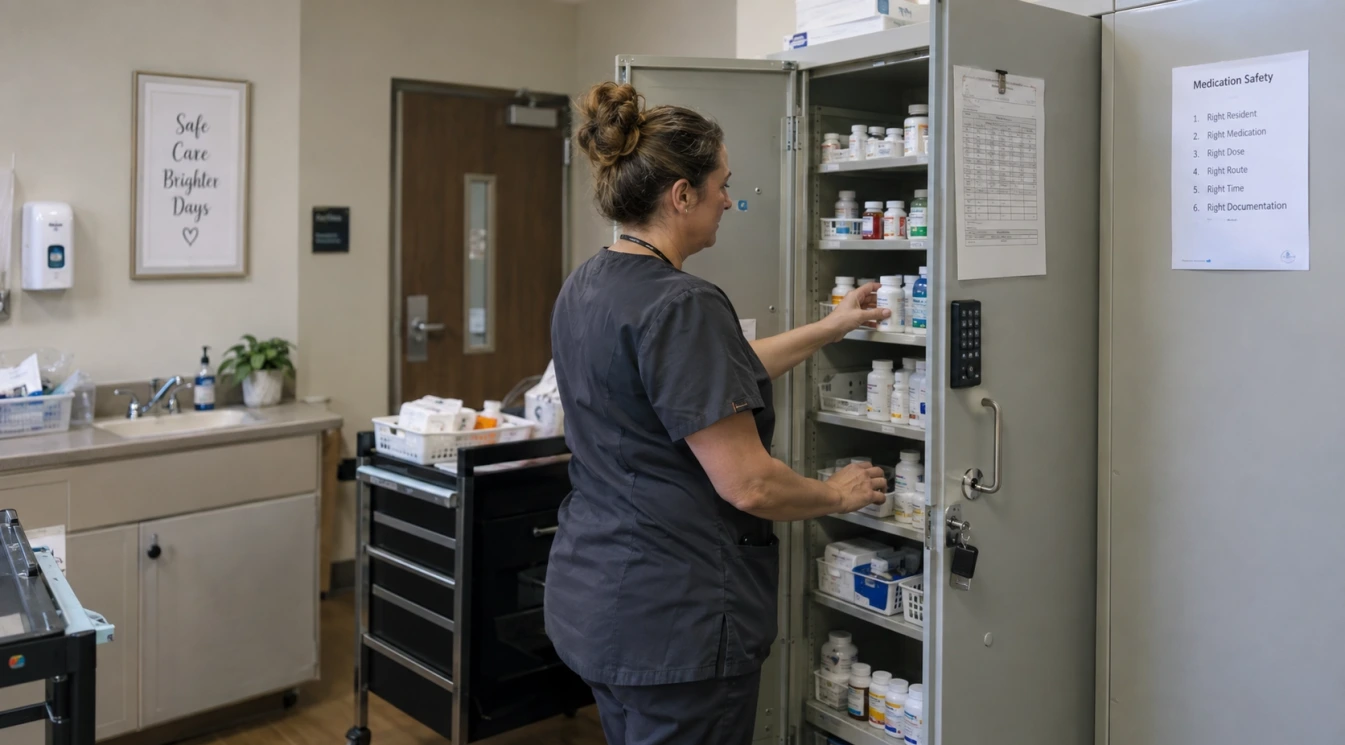
When medications are centrally stored, California regulations require them to be kept in a safe and locked location that is not accessible to people other than employees responsible for supervising those medications. Prescription labels are also important; facility staff should not alter a prescription label, and the medication should be maintained according to applicable storage and labeling requirements.
The facility must maintain a record of centrally stored prescription medications for each resident for at least one year. Those records can help show which medication was on hand, when a prescription was filled, which pharmacy issued it, and whether the facility’s documentation matched the labeled container.
PRN Medications Require More Than “Give as Needed”
PRN medications are taken “as needed” rather than on a fixed schedule. They can include medications for pain, anxiety, constipation, nausea, sleep, or other symptoms. In assisted living, the rules become more detailed because the resident’s ability to recognize and communicate the need for the medication matters.
If the physician has documented that a resident can determine and communicate the need for a PRN medication, staff may assist with self-administration consistent with that authorization. When a resident cannot determine the need independently, California regulations impose additional requirements depending on whether the resident can clearly communicate symptoms.
For example, when a resident cannot determine the need for a prescription or nonprescription PRN medication and also cannot clearly communicate symptoms, designated facility staff must contact the resident’s physician before each dose, describe the symptoms, receive direction, and document the contact and the resident’s response.
That distinction can be particularly important for residents with dementia or cognitive impairment. A bottle labeled “as needed” does not give an unlicensed caregiver unrestricted discretion to decide when a resident should take the medication.
The Resident Still Has the Right to Refuse Medication
A resident’s refusal can create a difficult situation, especially when the medication is important. But the refusal does not authorize staff to force the medication or hide it in food without the resident’s knowledge and consent.
A refusal may also provide useful information. The resident may be experiencing nausea, dizziness, difficulty swallowing, sedation, pain, or another side effect. The resident may not understand why the medication was prescribed, or the medication may have recently changed.
The appropriate response depends on the medication, the resident’s condition, and the circumstances. Repeated refusals or new symptoms may need to be communicated to the prescribing practitioner rather than treated as a routine charting issue.
Diabetes and Injectable Medications Need Special Attention
California permits an assisted living facility to accept or retain a resident with diabetes when the resident is able to perform glucose testing and administer medication independently, or when those services are performed by an appropriately skilled professional. Facility staff may still provide permitted assistance with self-administered medication.
This matters because insulin and other injectable medications raise different issues from ordinary oral medication assistance. Unlicensed staff are not authorized by these rules to administer injections. If a resident loses the ability to self-inject safely, the facility may need to arrange for an appropriately skilled professional or reassess whether the resident’s care needs can still be met in assisted living.
Our article on when an assisted living facility can no longer meet a resident’s care needs explains the broader issue of changing health needs and the limits of the assisted living model.
Medication Problems Can Look Like a Change in the Resident’s Condition
Medication errors and adverse effects do not always look like a medication problem. An older adult may become unusually sleepy, confused, weak, dizzy, unsteady, agitated, or less responsive. A resident may fall, stop eating normally, experience a sudden blood-pressure change, or appear very different from the person family members saw a few days earlier.
Those symptoms can have many causes, including illness or the resident’s underlying medical condition. When a significant change occurs, however, it may be important for appropriate health professionals to consider medication timing, recent prescription changes, missed doses, duplicate medications, and possible adverse effects rather than attributing the change to age or dementia alone.

Warning Signs of a Medication-Management Problem
A family may have reason to ask more questions when:
- Medication bottles or lists do not match the resident’s current prescriptions
- Staff cannot explain when a medication was started, stopped, or changed
- The resident repeatedly runs out of a medication
- Several doses are missing from the facility’s medication record
- PRN medications are repeatedly used without clear documentation
- Unsecured prescription medications are found in common areas or accessible locations
- The resident becomes unusually sedated, confused, weak, or unsteady after a medication change
- Different caregivers give conflicting explanations about the medication routine
- The family is told that an unlicensed caregiver is giving injections or making independent medication decisions
- A medication problem is discovered after hospitalization but the facility cannot reconstruct what happened
One irregularity does not prove neglect. A pattern of missing records, inconsistent explanations, unsafe storage, or unexplained changes in the resident’s condition can justify a closer review of the medication process.
Records That May Help Explain What Happened
When a serious medication problem is suspected, useful records may include:
- The resident’s current medication list and physician orders
- Pharmacy labels and refill history
- Centrally stored medication records
- Medication-assistance records or other medication documentation used by the facility
- PRN authorizations and PRN response documentation
- Hospital discharge medication lists
- Progress notes and documentation of changes in condition
- Communications with physicians, pharmacies, home health, and family members
- Staff medication-training records
- Incident reports involving falls, altered mental status, or medication concerns
- Hospital, ambulance, and emergency department records after a serious event
Other potentially useful information can include photographs of medication containers or written medication lists lawfully obtained, along with contemporaneous notes about changes in the resident’s condition. Our guide to preserving evidence after suspected elder abuse or neglect discusses other information that can help reconstruct a care problem.
When Medication Errors May Point to Assisted Living Neglect
Medication errors can happen even in a well-run facility, and an unexpected medical outcome does not by itself establish neglect. The circumstances matter.
Concerns become more significant when the facility repeatedly fails to follow current medication orders, allows inadequately trained staff to assist residents, exceeds the limits of unlicensed medication assistance, leaves centrally stored medications unsecured, fails to document required PRN use, or does not respond appropriately when the resident develops significant symptoms.
Newman Law Group represents residents and families in matters involving elder neglect, assisted living medication errors, inadequate supervision, and failures to provide appropriate care. A legal review may consider the resident’s prescriptions, medication records, staff training, pharmacy information, facility policies, and medical evidence concerning any resulting injury.
Contact Newman Law Group to discuss a serious assisted living medication concern, or call 9169320397.
This article provides general legal and care information and is not advice for a particular resident, medication, or facility. Medication decisions should be made by qualified health professionals, and the duties of an assisted living facility can depend on the resident’s condition, current orders, and the type of assistance required.